01
Discover
Read a URL or an idea. Return the niche, hashtags, and accounts worth modelling. Drop any account the provider cannot verify.
Viral OS Engine
Turn a website, an idea, or a list of accounts into a playbook, the next two weeks, a scored hook, and a link you can send.
Hook Lab
Sample run01 — How it works
Six stages, in order. The same pipeline for every brand. The brand arrives only as the job input.
Read a URL or an idea. Return the niche, hashtags, and accounts worth modelling. Drop any account the provider cannot verify.
Pull posts on TikTok, Instagram, YouTube, X, LinkedIn, and Facebook. Normalise every post to one shape.
Engagement points, a top-performer flag, a viral score from 0 to 100 inside this run, and an outlier against that creator’s own median.
Fetch comments and transcripts for the strongest posts. Long YouTube transcripts are summarised before they are analysed.
For each shortlisted post: sentiment, usefulness, the questions people ask, and a short insight.
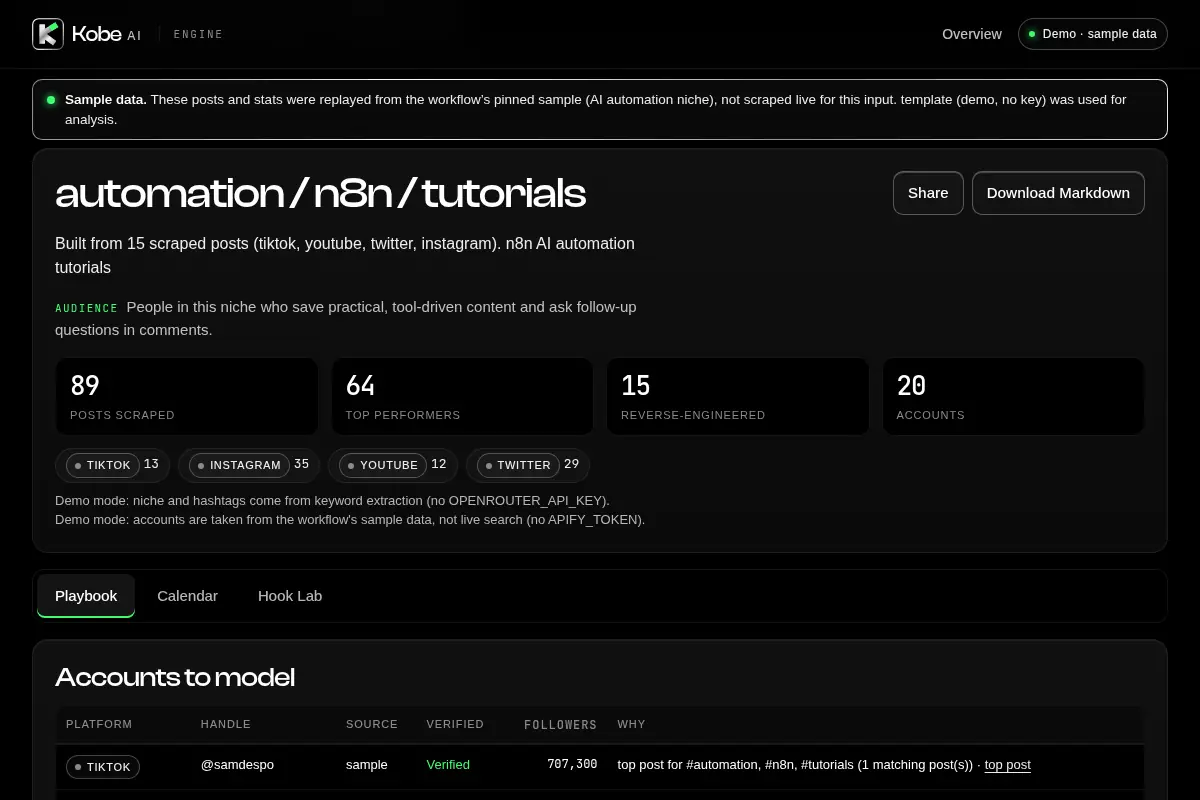
A playbook for each top post, plus one for the niche: patterns, hooks, formats, ideas, do and don’t, and cadence. Download it as Markdown.
02 — Engine
Three ways to start. Kobe does not special-case a brand. You bring the input.
Kobe fetches the page text behind an SSRF guard, then asks the model for a niche, hashtags, and candidate accounts. Unverified accounts are dropped. Authors of strong posts for those hashtags fill the gaps.
Describe the product in plain language. Discovery runs from that description instead of a page.
Pass lines of platform:handle, plus hashtags, when you already know who to model. Company pages use linkedin:company/name.
03 — The loop
Find what's already working. Plan the next two weeks. Sharpen the line. Then send the playbook.
Find what's viral. Public posts are scored inside this run. The playbook names the patterns, the hooks, the formats, and the next ideas.
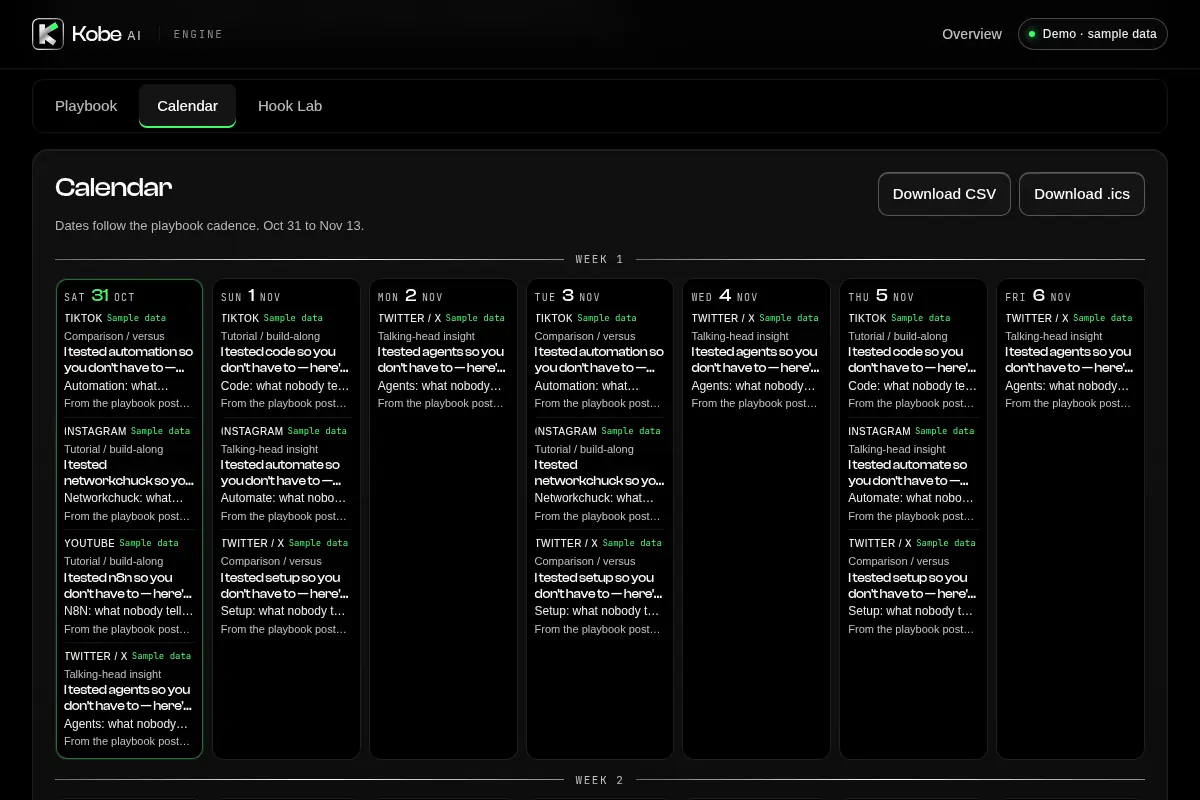
Plan it. The next two weeks come from that playbook, one post at a time. Download the plan as a spreadsheet or a calendar file.
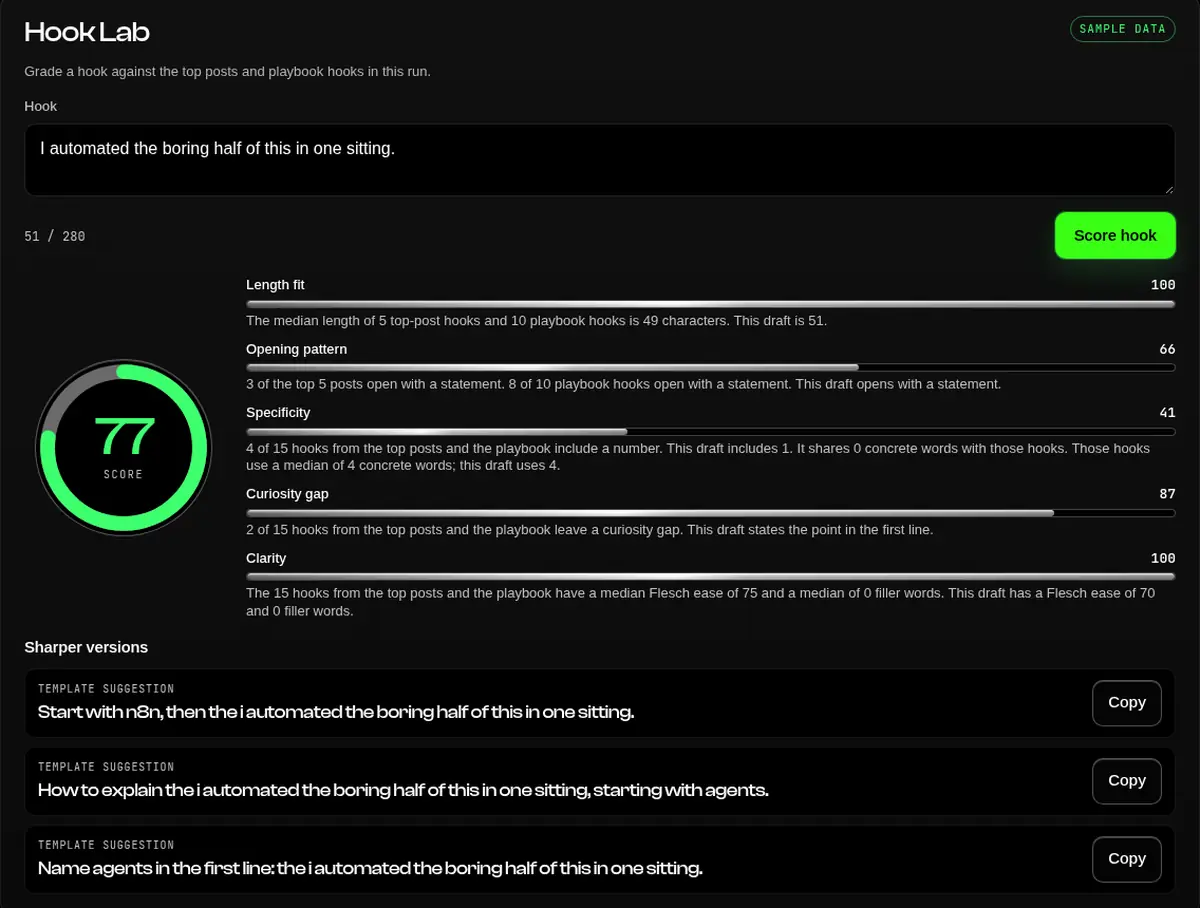
Sharpen it. Paste a hook. Kobe scores it against the hooks in this run: length, opening, specificity, curiosity, and clarity.
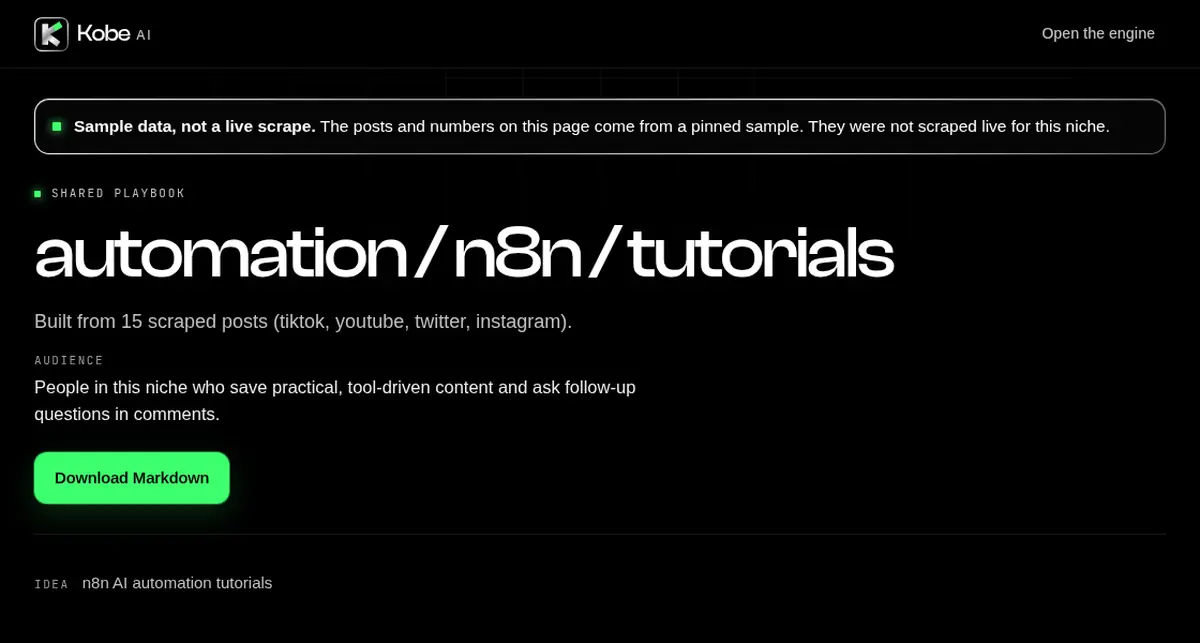
Share it. An opt-in link opens a read-only playbook. You can turn that link off.
04 — Brands
The Young Scientist Foundation, Wick & Edge, and Hook & Half. Same six stages. The brand is the input, not a separate product.
Point the engine at the foundation’s site, or describe the work in a sentence. Discovery builds the niche from that input.
Input · Website or idea
Trading platform for stocks and futures. Paper trading and simulation first.
Input · Website, idea, or accounts
Pass the accounts and hashtags you already trust. Kobe scrapes, scores, and writes the playbook. The stages do not change.
Input · Accounts and hashtags
Run it
A run starts from a URL, an idea, or a list of accounts. You leave with a playbook, a calendar, a scored hook, and a link.
05 — Early access
Tell us the brand and what you want it known for. We write to the work email you leave about access.
Early access opens soon.